
The Real Difference Between a Landing Page and a Homepage
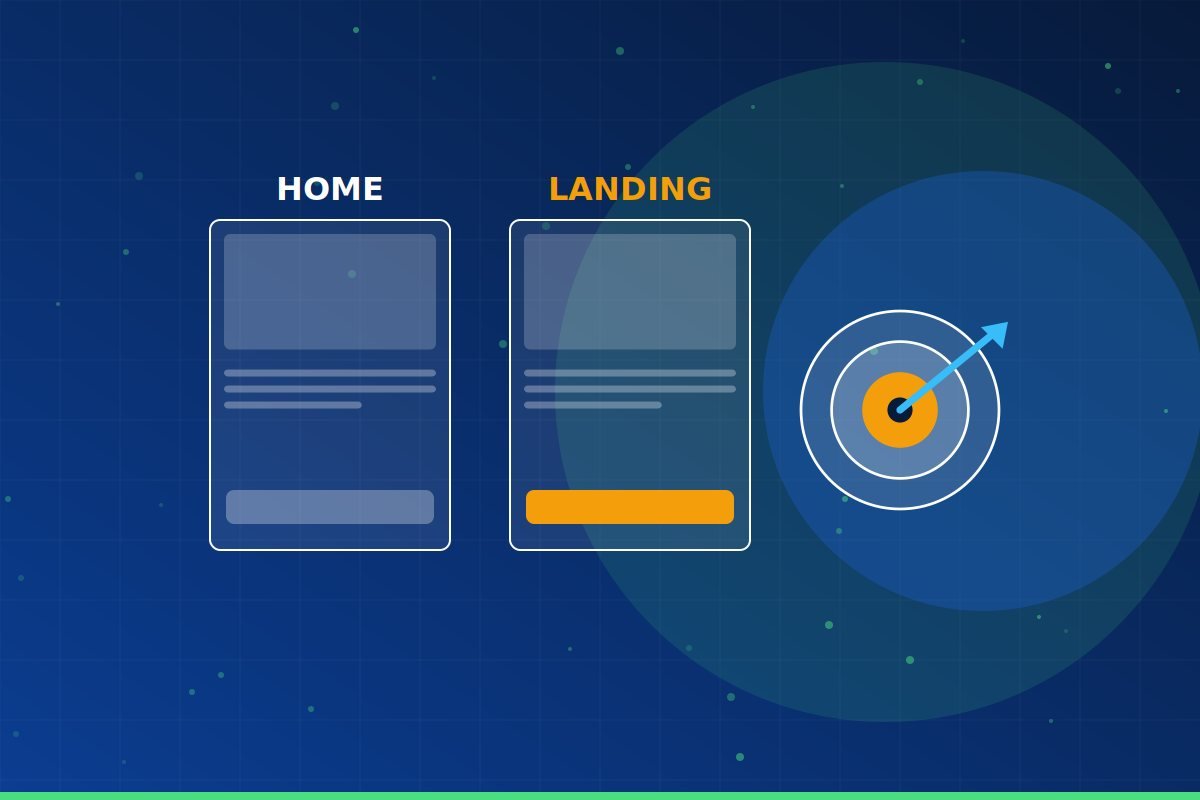
One of the most common, and most costly, mistakes in paid marketing is sending campaign traffic to a homepage instead of a dedicated landing page. They look similar at a glance — both are web pages with a headline and a call to action — but they're built to do fundamentally different jobs.
Understanding the difference isn't just a semantic distinction. It's often the single biggest lever available for improving the return on a paid campaign, frequently outweighing changes to targeting or bid strategy.
A homepage serves everyone. A landing page serves one person.
A homepage has to accommodate every type of visitor — someone who's never heard of you, an existing customer, a job applicant — which necessarily means navigation, multiple calls to action, and content covering many different needs at once.
A landing page is built for exactly one visitor type, arriving with exactly one specific intent, usually from a specific ad or campaign — which means every design and copy decision can be made in service of that one visitor's one likely next step.
Navigation is a feature on a homepage. It's a liability on a landing page.
On a homepage, navigation helps visitors find whatever they're looking for. On a landing page, navigation is an exit — every additional link is a way for a visitor to leave before completing the one action the page exists to drive.
This is why well-built landing pages typically strip navigation down to nothing, or close to it — not as an oversight, but as a deliberate choice to remove every path away from the conversion goal.
Message match matters more on a landing page
A homepage's headline has to work reasonably well for many different traffic sources at once. A landing page's headline should directly continue the exact message a visitor just saw in the ad, email, or search result that brought them there.
This continuity, often called message match, measurably affects conversion rate — a visitor who clicked an ad about a specific offer and lands on a page that immediately confirms they're in the right place converts at a meaningfully higher rate than one who lands somewhere generic.
Even small wording mismatches between an ad's headline and a landing page's headline can create enough hesitation to noticeably reduce conversions, which is why we treat ad copy and landing page copy as one connected writing task rather than two separate deliverables.
This is also why landing pages built in isolation from the campaign that will drive traffic to them tend to underperform — the two need to be planned together from the start, not handed off separately between a marketing team and a design team.
When a homepage actually is the right destination
Not every campaign needs a dedicated landing page — brand awareness campaigns, or campaigns where the goal is general site exploration rather than one specific conversion, can reasonably point to a homepage.
But for any campaign built around a specific offer, promotion, or lead-generation goal, a dedicated landing page consistently outperforms sending that same traffic to a general homepage, and the gap is usually large enough to be worth the extra build effort.
The bottom line for paid campaigns
If you're running or planning to run paid campaigns and currently sending that traffic to your homepage, a dedicated landing page is very likely the highest-leverage single change available to improve results — often more impactful than adjusting budget, targeting, or bidding strategy.
How to prioritize which campaigns get one first
If building a dedicated landing page for every campaign feels like too much at once, start with whichever campaign has the highest spend or the clearest, most specific offer — that's where message mismatch is costing the most, and where a dedicated page will show the fastest, most measurable return.
From there, treat landing pages as a standard part of campaign setup rather than an optional extra — once the first one proves out, the pattern is usually straightforward to repeat for the next campaign.
Over time, a small library of reusable landing page templates, adapted per campaign, tends to be far more efficient than building every page fully from scratch, without sacrificing the message match that makes dedicated pages worth the effort in the first place.
Want to see this applied to your business?
Book a free consultation and we'll walk through what's realistic for your team.
Book a Free ConsultationRelated posts
 Industry Insights
How AI Automation Is Changing Property Management
Property managers are quietly automating the parts of the job that used to eat every afternoon — here's what that actually looks like in practice.
July 14, 2026 5 min read Digital Marketing
5 SEO Mistakes Local Businesses Make
Most local SEO problems aren't technical — they're the result of a handful of avoidable, repeated mistakes.
June 2, 2026 4 min read
Get insights in your inbox
One email a month — practical automation and marketing notes, no fluff.